

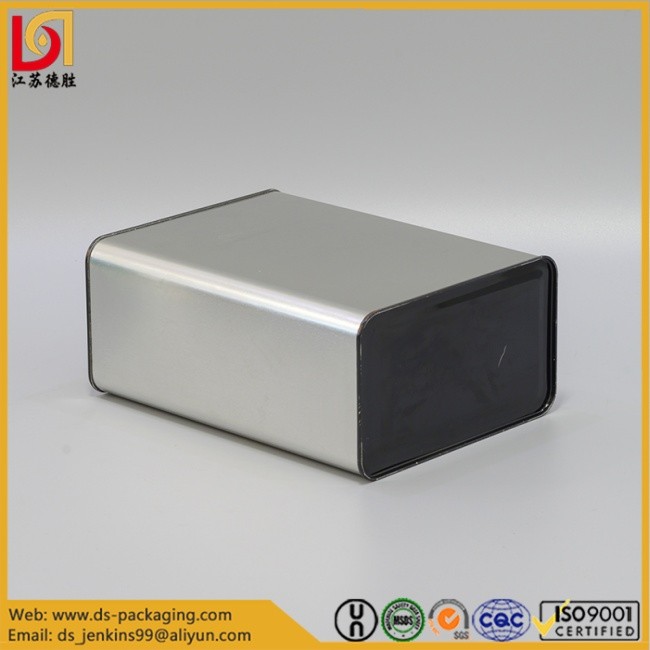
Products Description
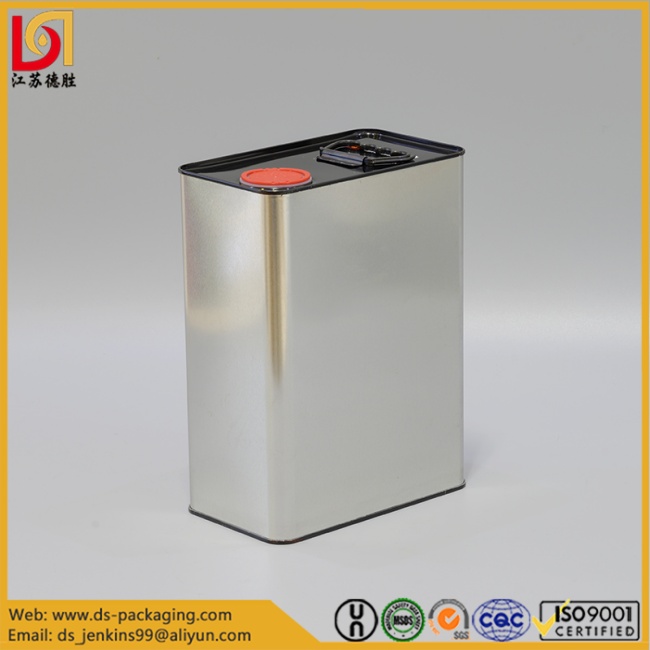
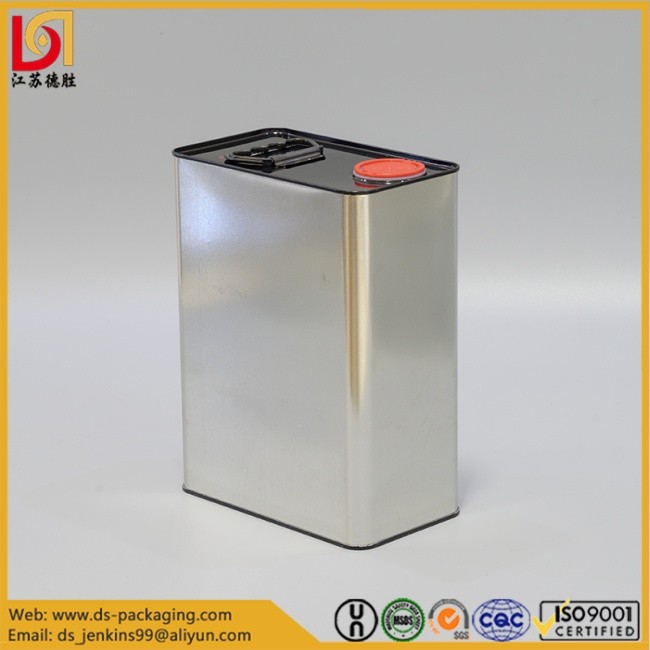
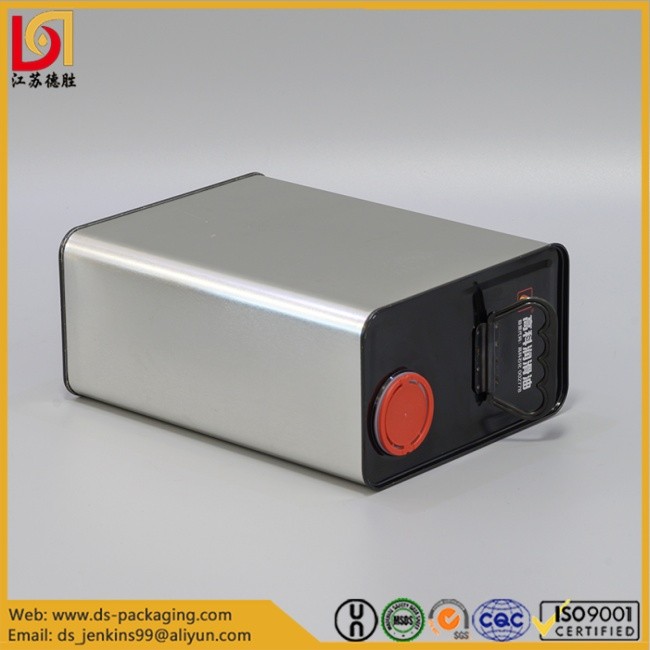
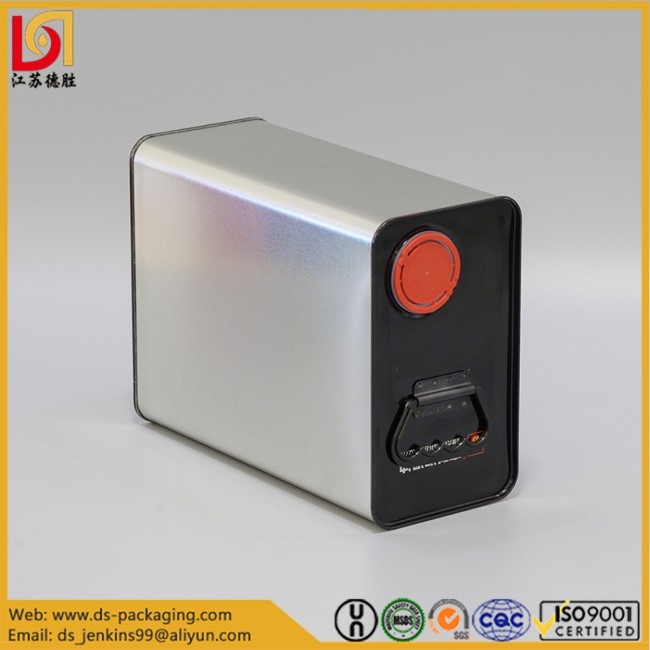
This is one of DS Metal Packaging's featured 4 Liters Rectangular Motor Oil Metal Cans. It not only supports CMYK printing on the can body, but also supports printing on the bottom and top cover. The minimum order quantity for the bottom and cover printing of 4 liters Metal Oil Can is only 6,000 pieces. Make your Motor Oil Tin Can stand out from the crowd of packaging products and attract customers' attention!
Product Parameters
| Product Name | Metal Oil Cans For Sale / 4L Empty F-style Metal Tin Can with Spout |
| Capacity | 4 Liter |
| Thickness (mm) | 0.23-0.28mm or Customized |
| Size (mm) | 180 (L) x 105 (W) x 240(H) mm or make a new mold |
| Outside | CMYK printing |
| Inside | Lacquered with 100% Phenolic epoxy resin |
| MOQ | 6000pcs for inner coating / external customized printing |
| Certificate | MSDS, ISO 9001, UN approved |
| Sample | 2pcs are free of charge, customers just need to pay for the freight |
| Customization | 1) sample can for us to copy |
| 2) layout or 3D drawing of the tin can or design | |
| 3) the size of the tin can | |
| Payment | 30% T/T deposit in advance and 70% before shipment or Negotiated Method |
| Delivery time | About 25 days after payment and sample confirmed |
Product Details
Base Material: Tinned Cold-rolled Steel Plate
1. Material code: usually SPTE (Steel Plate Tin Electrolytic) or tinned plate that complies with JIS G 3303, ASTM A623 and other standards.
2. Thickness range: 0.18mm - 0.50mm (common range, depending on the tank size, capacity and strength requirements). The tinplate thickness generally used by DS Packaging is as follows:
- 0.37L, 0.8L, 1L, Half Gallon, 2L, 2.5L, 1 Gallon, 4L, 5L cans use 0.23mm, 0.25mm, 0.28mm
- 10L~15L cans may use 0.28mm, 0.32mm, 0.35mm,
- 18L, 5 gallon, 20L, 23L steel pail will use 0.32mm, 0.35mm, 0.38mm, 0.40mm, 0.42mm, 0.45mm, 0.5mm
3. Tin plating amount: usually use 2.8/2.8 (tin plating amount on both sides is 2.8g/m²) or similar levels (such as E2.0/E2.0, E5.6/E5.6, according to customer requirements). For food grade or high corrosion resistance requirements, a higher tin plating amount will be selected.
4. Surface treatment:
- Bright: standard glossiness.
- Matte: matte, no glossiness.
- Stone: specific texture, conducive to paint adhesion or reduce reflection.
5. Tempering degree: such as T-2.5, T-3, T-4CA, etc., representing the hardness/toughness of the steel plate. F-style cans often use T-2.5 or T-3 to balance formability and strength.
Key Features and Advantages
1. Durability and Sealing: Seamless tank or double-seam leak-proof structure ensures leak-free operation over long periods and can handle heavy-duty conditions.
2. Multi-functional Nozzles: Many models are equipped with both rigid metal tubes and flexible nylon/braided hoses, allowing users to switch between them as needed to adapt to direct lubrication or bypass lubrication in confined spaces.
3. Flexible Pumping Methods: Typically equipped with a thumb-press lever or steel trigger, operation is simple and allows for on-demand oil pumping.
4. Easy Maintenance: Some designs consider ease of cleaning; parts are easy to disassemble and clean.
Usage and Maintenance Tips
Cleaning Method: To clean the inside of the oil can, use a mixture of hot water, degreasing detergent, and one tablespoon of white vinegar, along with a stiff brush, to scrub.
Disposal Note: Old metal oil cans are generally not recyclable because they may contain residual machine oil, which is considered hazardous waste. It is recommended to take them to your local waste recycling center or landfill for professional disposal.
Production Process


1. Prepare raw materials 2. Tin plate incoming quality checking
3. Making a new printing plate 4. Customized printing
5. Printing quality checking 6. Cutting printed tinplate
7. Curling the can body 8. Welding straight seam
9. Shaping into square 10. Top cover & bottom forming
11. Top cover, body and bottom assembled
12. Tightness test 13. Packing
14. Warehouse 15. Shipping
Production Line Automation and Efficiency
1. Production speed: For example, the actual stable production capacity of DS Packaging's 4L Rectangular Tin Can is 65~85pcs/minute, and the daily output (24 hours) is 93,000~22,000pcs; the actual stable production capacity of 20L Conical Tinplate Pails is 28~38pcs/minute, and the daily output (22 hours) is 37,000~50,000pcs, which fully meets the needs of large-volume orders.
2. Specification switching: The production line supports specification switching (such as can height and diameter adjustment) within 30 minutes, without complex tools, reducing downtime.
3. Fast assembly of accessories: Key components (such as upper cover punching and sealing molds) adopt modular design and can be replaced within 5 minutes, reducing downtime.
4. Automation degree: The entire line adopts a PLC control system to realize the integration of automatic welding into rounding, square, flanging, sealing, and airtightness detection, reducing manual intervention and improving efficiency by more than 30%.
Cost Optimization Plan and Cost Reduction Design
1. Thinning process: Tinplate cans with a capacity of 10 liters or less can choose thinner raw materials, with a thickness ranging from 0.28mm to 0.23mm, but the MOQ of thinner tinplate is more stringent, so we need to prepare in batches.
2. Energy-saving equipment: drying oven waste heat recovery system (energy consumption reduced by 30%)
3. Flexible MOQ: The MOQ of metal cans of different capacities is different. MOQ is determined by the MOQ of printing. For example, the MOQ of 1 liter metal printing is 12,000pcs, the MOQ of 1 gallon/4 liter/5 liter metal can is 6,000pcs, the MOQ of 5 liter~10 liter metal can is 3,000pcs, and the MOQ of 18 liter~23 liter metal barrel is 2,000pcs; if it is a hot-selling model, the MOQ can be less and printed together with our other customers' orders; if the order cannot be printed, we can spread the printing cost to each Metal Can.
4. Mould fee: Generally speaking, if the cumulative order volume reaches 500,000 pieces, the custom mould fee will be fully refunded.


