

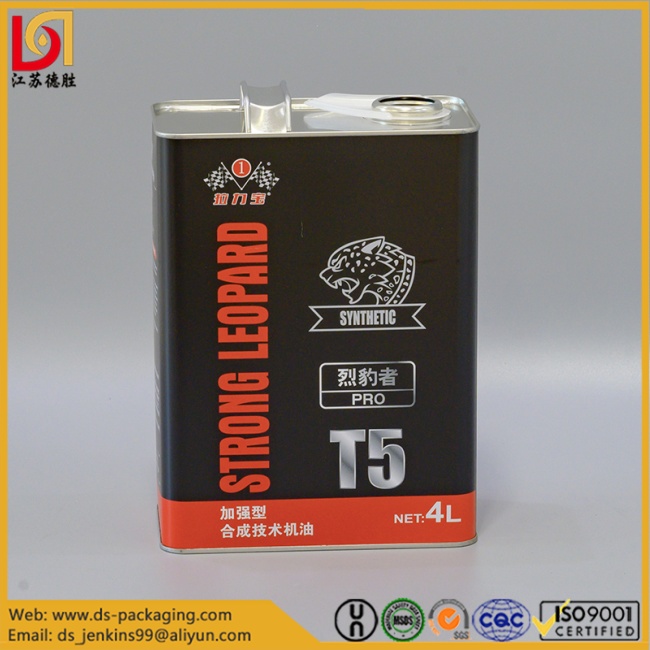
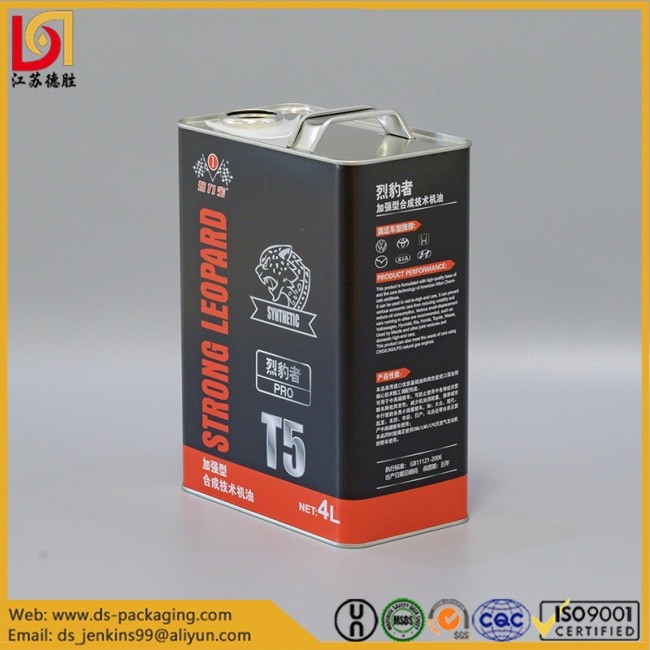
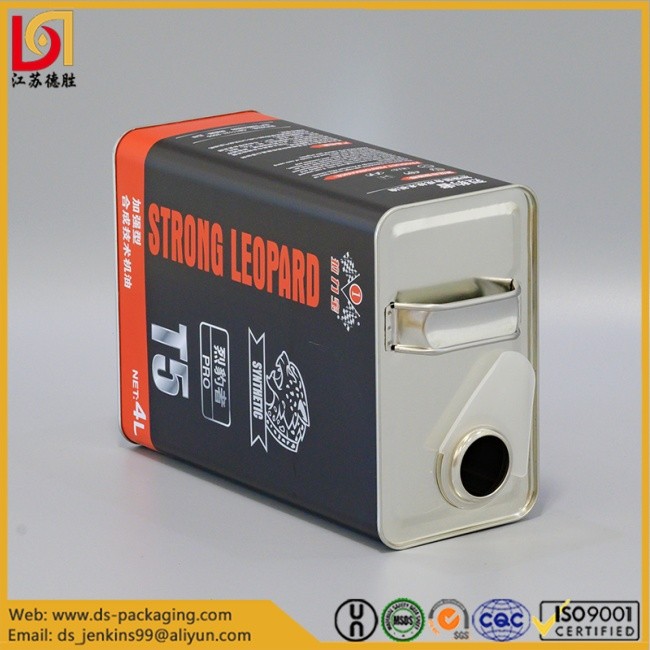
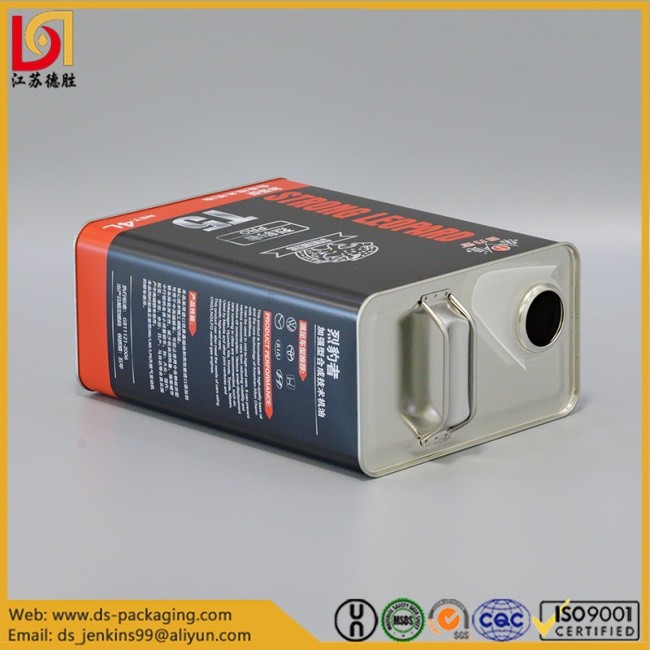
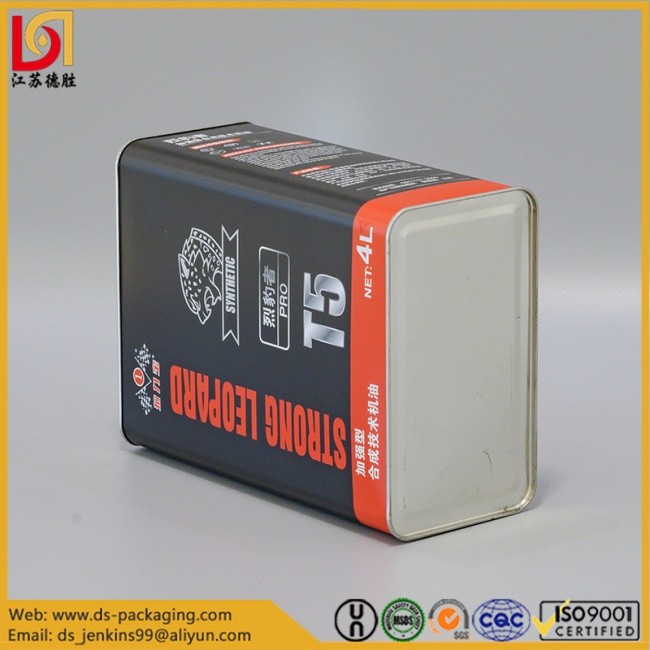
Products Description
Motor oil cans are professional packaging containers specifically designed for motor oil, widely used in the storage, transportation, and refilling of motor oil in automobiles, motorcycles, and construction machinery. The main materials are tinplate and high-density polyethylene (HDPE), emphasizing leak-proofness, oil corrosion resistance, strong sealing, and easy recyclability. They are available in capacities from 0.8L to 200L and represent the standard packaging solution in the lubricating oil industry.
Product Parameters
| Product name: 4L Square F-style Motor Oil Tin Can with Metal Squeeze Cap and Spout | |||
| Material | Prime Tinplate | Shape | Oblong |
| Size | Length: 180mm | Printing Color | White / Silver / CMYK printing |
| Width: 105mm | MOQ | 6000pcs for customized Logo | |
| Height: 240mm | Certification | ISO9001, SGS, MSDS, UN approved | |
| Capacity | 4 Liter | Lead Time | About 25 days |
| Thickness | 0.23-0.28mm or customized | Application | For chemical liquid packaging |


Base Material: tinned cold-rolled steel plate
1. Material code: usually SPTE (Steel Plate Tin Electrolytic) or tinned plate that complies with JIS G 3303, ASTM A623 and other standards.
2. Thickness range: 0.18mm - 0.50mm (common range, depending on the tank size, capacity and strength requirements). The tinplate thickness generally used by DS Packaging is as follows:
- 0.37L, 0.8L, 1L, Half Gallon, 2L, 2.5L, 1 Gallon, 4L, 5L cans use 0.23mm, 0.25mm, 0.28mm
- 10L~15L cans may use 0.28mm, 0.32mm, 0.35mm,
- 18L, 5 gallon, 20L, 23L steel pail will use 0.32mm, 0.35mm, 0.38mm, 0.40mm, 0.42mm, 0.45mm, 0.5mm
3. Tin plating amount: usually use 2.8/2.8 (tin plating amount on both sides is 2.8g/m²) or similar levels (such as E2.0/E2.0, E5.6/E5.6, according to customer requirements). For food grade or high corrosion resistance requirements, a higher tin plating amount will be selected.
4. Surface treatment:
- Bright: standard glossiness.
- Matte: matte, no glossiness.
- Stone: specific texture, conducive to paint adhesion or reduce reflection.
5. Tempering degree: such as T-2.5, T-3, T-4CA, etc., representing the hardness/toughness of the steel plate. F-style cans often use T-2.5 or T-3 to balance formability and strength.
Design and Structural Features
1. Shape: Primarily round and square (F-style). Square cans (usually rectangular with rounded corners) are very popular in the retail market due to their high space utilization and ease of packing and stacking.
2. Sealing: Designed with leak-proof and sealing structures, such as screw-on lids or tamper-evident caps, ensuring that the oil does not leak or oxidize during transportation and storage.
3. Ergonomics: Large-capacity cans (such as 5L) are usually designed with metal or plastic handles for easy handling and pouring.
4. Stackability: The lid and bottom of the can usually have corresponding grooves or reinforcing ribs, allowing empty or full cans to be stacked stably, saving storage space.
Our Factory
Yixing Desheng Metal Package Products Co., Ltd., as a ODM & OEM which is one of the longest tin can factories in Jiangsu China, especially good at 0.8L~10L rectangular F-style cans and 10L~23L conical tinplate pails.
Our clients cover from domestic to overseas, such as Shandong SANTA ROSA, Chief Group, Beijing Monarch, China State Shipbuilding Corporation, South Korea KCC, Japan Toyo Ink, American Backdrop, Saudi AKT etc. We guarantee the delivery time and have a sound after-sales policy. With leakage testing machine for each can, almost 0 leakage. International standard leakage is 3‰. If exceeds this and our responsibility, we'll make the best compensation solution.
The biggest feature for tinplate containers is that it is cheap and not easy to be imitated / faked. In response to the global call for environmental protection, I sincerely recommend using our tin cans!

Compliance and Certification
1. UN certification: For steel drums used for dangerous goods packaging, China Customs will test UN performance tests and obtain corresponding certification (such as 1A1/X1.4/250/S...).
2. Food grade certification: The inner coating must comply with food contact material regulations of FDA, EU or other target markets.
3. Other standards: such as ISO, MSDS, SGS and other customer-specific standards.


